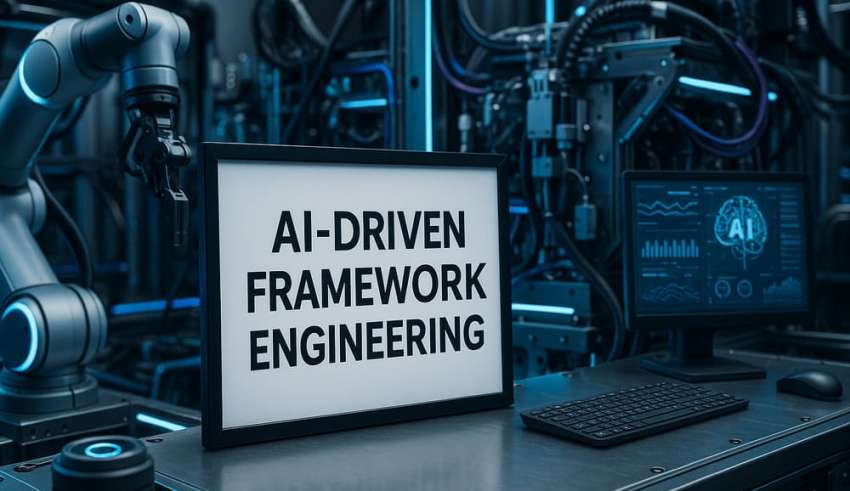
AI-Driven Framework Engineering
By Mohamad Haitan Rachman — Creator of “EB2P, Negeri Framework and AI Ecosystem”
1. Introduction: Why Framework Engineering Needs AI
The modern world is defined by complexity. Organizations manage massive amounts of data, governments face interconnected policy challenges, and individuals must learn and adapt continuously. In this environment, frameworks—structured ways of thinking and acting—have become essential. They help people make sense of complexity, align actions, and create value.
At the same time, Artificial Intelligence (AI) has transformed how knowledge is generated, analyzed, and applied. AI can process information at a scale and speed far beyond human capability. However, AI without structure can be inconsistent, shallow, or misaligned with human goals.
This is where AI-Driven Framework Engineering emerges. It is the discipline of designing, developing, applying, and evolving frameworks with AI as an active partner, not just as a tool. AI-Driven Framework Engineering ensures that frameworks are smarter, adaptive, scalable, and continuously improved through human–AI collaboration.
2. What Is AI-Driven Framework Engineering?
AI-Driven Framework Engineering can be defined as:
A systematic approach to creating and evolving frameworks in which artificial intelligence supports analysis, synthesis, testing, adaptation, and scaling, while humans provide meaning, values, and strategic direction.
In this approach:
- Frameworks provide structure, logic, and purpose.
- AI provides speed, pattern recognition, simulation, and learning.
- Humans provide judgment, ethics, creativity, and contextual understanding.
The result is a living system where frameworks are not static models, but adaptive thinking architectures.
3. From Traditional to AI-Driven Framework Engineering
a.Traditional Framework Engineering
Traditionally, frameworks were:
- designed by humans,
- documented in books or presentations,
- applied manually,
- updated infrequently.
They were powerful, but often slow to evolve and difficult to scale.
b. AI-Driven Framework Engineering
With AI, frameworks become:
- dynamically tested in real contexts,
- enriched with data-driven insights,
- continuously refined,
- easier to personalize and scale.
AI does not replace framework designers—it amplifies their capability.
4. The Core Components of AI-Driven Framework Engineering
a. The Framework as the Thinking Architecture
A framework defines:
- key stages or dimensions,
- relationships between elements,
- decision logic,
- learning loops.
In AI-Driven Framework Engineering, this architecture acts as the operating system for reasoning—used by both humans and AI.
b. AI as the Intelligence Engine
AI supports framework engineering by:
- analyzing large datasets,
- identifying patterns and gaps,
- simulating scenarios,
- summarizing insights,
- generating alternatives,
- accelerating iteration.
AI turns frameworks into data-aware and evidence-based systems.
c. Humans as Meaning-Makers
Humans remain central. They:
- define purpose and values,
- interpret AI outputs,
- ensure ethical alignment,
- contextualize decisions,
- guide long-term vision.
AI-Driven Framework Engineering is human-centered, not AI-centered.
5. The Lifecycle of AI-Driven Framework Engineering
AI-Driven Framework Engineering typically follows a continuous lifecycle:
a. Discovering the Core Purpose
Every framework starts with a clear intent:
- What problem does it solve?
- What value should it create?
- Who will use it?
AI can analyze trends and challenges, but humans define purpose.
b. Designing the Framework Structure
Humans design the core structure:
- stages, steps, or dimensions,
- logical flow,
- principles and definitions.
AI assists by comparing patterns across domains and suggesting optimizations.
c. Applying the Framework
The framework is applied in real situations:
- projects,
- organizations,
- learning environments,
- AI agents.
AI helps generate outputs consistent with the framework logic.
d. Evaluating and Learning
AI collects feedback, performance data, and usage patterns. It helps answer:
- What works well?
- Where does the framework fail?
- Which steps need refinement?
e. Iterating and Evolving
Based on learning, the framework is refined:
- simplified,
- expanded,
- adapted to new contexts.
This makes frameworks living systems, not static diagrams.
6. Why AI-Driven Framework Engineering Matters
a. Managing Complexity
AI-driven frameworks help humans navigate complexity by organizing information into coherent structures.
b. Accelerating Learning and Innovation
AI speeds up experimentation, allowing frameworks to be tested and improved rapidly.
c. Scaling Best Practices
Once a framework is proven, AI helps replicate and scale it across teams, organizations, or regions.
d. Reducing Cognitive Overload
Frameworks supported by AI reduce mental strain by guiding thinking and automating routine analysis.
7. Domains of Application
AI-Driven Framework Engineering can be applied across many domains:
a. Knowledge Management
Frameworks structure how knowledge is captured, organized, shared, and transformed into value—while AI automates analysis and retrieval.
b. Innovation and Product Development
Frameworks guide idea generation, prototyping, validation, and scaling, while AI accelerates insights and iteration.
c. Education and Learning
Frameworks structure learning journeys, reflection, and skill development, with AI personalizing content and feedback.
d. Organizational Transformation
Frameworks guide change management, leadership development, and performance improvement, supported by AI analytics.
e. AI Agents and Intelligent Systems
Frameworks define how AI agents reason, decide, and interact—ensuring consistency and alignment with human goals.
8. AI-Driven Framework Engineering vs Prompt Engineering
Prompt engineering focuses on crafting inputs to get better AI responses. AI-Driven Framework Engineering goes deeper:
- Prompt engineering is tactical.
- Framework engineering is architectural.
Frameworks define the logic behind prompts, making AI behavior consistent, explainable, and scalable.
9. Ethical and Strategic Considerations
AI-Driven Framework Engineering must address:
- transparency: understanding how decisions are made,
- accountability: who is responsible for outcomes,
- bias mitigation: avoiding unfair or misleading structures,
- long-term impact: ensuring frameworks serve human well-being.
Frameworks provide ethical guardrails for AI reasoning.
10. Benefits of AI-Driven Framework Engineering
When done well, it delivers:
- clearer thinking in complex environments,
- faster and better decision-making,
- shared language across stakeholders,
- continuous improvement,
- scalable innovation,
- stronger alignment between humans and AI,
- sustainable value creation.
11. The Future of AI-Driven Framework Engineering
As AI becomes more embedded in daily work, frameworks will become:
- more adaptive,
- more personalized,
- more integrated across domains.
AI-Driven Framework Engineering will evolve into a core capability for organizations and societies that want to remain resilient, innovative, and human-centered.
12. Conclusion
AI-Driven Framework Engineering represents a new way of designing how humans and AI think and work together. It combines structured frameworks, intelligent systems, and human values into a unified approach for navigating complexity and creating value.
In the AI era, success will not belong to those who merely use AI—but to those who can engineer the frameworks that guide AI and human intelligence toward meaningful outcomes.
If you are interested, please contact us at haitan.rachman@inosi.co.id