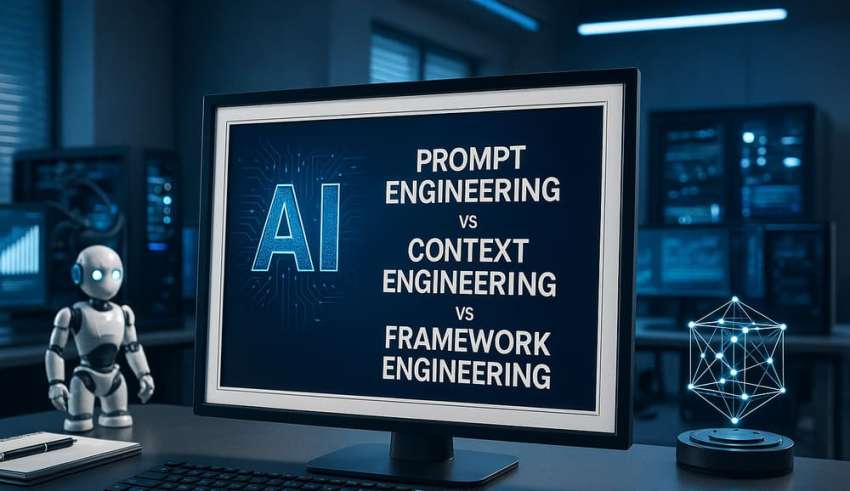
Prompt Engineering vs Context Engineering vs Framework Engineering
By Mohamad Haitan Rachman — Creator of “EB2P, Negeri Framework and AI Ecosystem”
1. Introduction: Why These Three Concepts Matter
As Artificial Intelligence—especially large language models—becomes widely used, new disciplines have emerged to help humans guide, control, and collaborate effectively with AI. Among the most discussed are Prompt Engineering, Context Engineering, and Framework Engineering.
Although these terms are often used interchangeably, they represent very different levels of abstraction and maturity in how humans design intelligence systems. Understanding their differences is crucial for educators, organizations, AI builders, policymakers, and innovators who want to move from short-term AI usage to long-term, scalable intelligence systems.
This article explains each concept clearly, compares them systematically, and shows how they relate to one another.
2. Prompt Engineering: Optimizing the Input
a. What Is Prompt Engineering?
Prompt Engineering is the practice of crafting effective instructions (prompts) to obtain better outputs from an AI model. It focuses on how a question or command is written.
A prompt may include:
- instructions,
- examples,
- constraints,
- tone or style guidance,
- desired format.
The goal is to maximize output quality from a single interaction.
b. Key Characteristics of Prompt Engineering
- Tactical and operational
- Focused on wording and structure of input
- Often trial-and-error based
- Works at the interaction level
- Output-oriented
Prompt engineering is about “What should I say to the AI to get the best answer right now?”
c. Strengths and Limitations
Strengths
- Fast and practical
- Low entry barrier
- Useful for daily tasks
Limitations
- Not reusable at scale
- Highly dependent on individual skill
- Lacks consistency across users
- Difficult to govern or standardize
Prompt engineering is powerful—but fragile when systems grow larger.
3. Context Engineering: Shaping the Environment
a. What Is Context Engineering?
Context Engineering goes beyond individual prompts. It focuses on designing the surrounding context in which the AI operates.
This context may include:
- system instructions,
- role definitions,
- memory rules,
- knowledge boundaries,
- conversation constraints,
- tone and values.
Context engineering answers the question: “In what environment should the AI think and respond?”
b. Key Characteristics of Context Engineering
- Strategic compared to prompt engineering
- Shapes AI behavior across interactions
- More stable than single prompts
- Focuses on alignment and consistency
- Often used in Custom GPTs or AI agents
c. Strengths and Limitations
Strengths
- Improves consistency
- Reduces repetitive prompting
- Enables role-based AI behavior
- Better alignment with goals
Limitations
- Still dependent on human-written instructions
- Limited structure for complex reasoning
- Hard to scale across domains without abstraction
Context engineering is about “How do we set the rules of the game?” But it does not fully define how thinking itself is structured.
4. Framework Engineering: Designing the Thinking System
a. What Is Framework Engineering?
Framework Engineering operates at a much deeper level. It is the discipline of designing structured thinking architectures that guide reasoning, decision-making, learning, and value creation—by humans, AI, or both.
A framework is not just an instruction. It is:
- a logical structure,
- a sequence of stages,
- a shared language,
- a repeatable reasoning model.
Framework Engineering answers: “What thinking structure should guide every prompt, context, and decision?”
b. Key Characteristics of Framework Engineering
- Architectural and systemic
- Reusable and scalable
- Domain-agnostic or domain-specific
- Testable and evolvable
- Can be embedded into AI, organizations, and ecosystems
Framework engineering creates thinking blueprints, not just instructions.
5. Comparing the Three Approaches
6. How They Work Together
These three are not competitors. They are layers.
- Framework Engineering defines how thinking should work.
- Context Engineering embeds the framework into the AI environment.
- Prompt Engineering executes tasks within that structure.
In other words:
Framework → Context → Prompt
Without frameworks:
- prompts become inconsistent,
- contexts become shallow,
- AI outputs lack coherence.
Framework engineering provides the foundation that makes the other two sustainable.
7. Why Framework Engineering Is Critical in the AI Era
a. AI Needs Structure, Not Just Instructions
AI can generate answers—but without frameworks, it lacks:
- reasoning discipline,
- value alignment,
- consistency across scale.
b. Organizations Need Repeatable Intelligence
Frameworks allow:
- standardized decision-making,
- knowledge transfer,
- organizational learning,
- governance and accountability.
c. Frameworks Enable AI-Human Collaboration
Framework engineering creates a shared logic between humans and AI, enabling:
- explainable reasoning,
- auditable decisions,
- ethical alignment.
8. Examples Across Domains
Education
- Prompt: “Explain this topic simply.”
- Context: “You are a patient teacher.”
- Framework: A structured learning framework guiding exploration, practice, reflection, and mastery.
Innovation
- Prompt: “Generate product ideas.”
- Context: “Act as a product strategist.”
- Framework: A full innovation lifecycle guiding need identification, prototyping, testing, and scaling.
Government
- Prompt: “Summarize this policy.”
- Context: “Act as a policy analyst.”
- Framework: A governance framework ensuring analysis, impact assessment, stakeholder alignment, and evaluation.
9. Long-Term Strategic Implications
- Prompt engineering improves productivity.
- Context engineering improves alignment.
- Framework engineering builds intelligence infrastructure.
In the long term, value will not come from who writes the best prompt—but from who designs the best frameworks.
Frameworks become:
- organizational operating systems,
- AI reasoning blueprints,
- knowledge-to-value pipelines.
10. Conclusion
Prompt Engineering, Context Engineering, and Framework Engineering represent three distinct but interconnected levels of AI collaboration.
- Prompt engineering optimizes what we say.
- Context engineering designs how AI behaves.
- Framework engineering defines how thinking itself is structured.
As AI becomes deeply embedded in society, Framework Engineering will emerge as the most strategic discipline, enabling scalable, ethical, and sustainable intelligence systems.
Those who master frameworks will not merely use AI—they will architect intelligence.
If you are interested, please contact us at haitan.rachman@inosi.co.id